ReactSOFT : AI-Knowledge Powered Synthesis and Process Design
AI-Driven Prediction of synthetic route, conditions, impurities and safety hazards
Developing an efficient synthetic route is often a complex and time-intensive process, requiring researchers to identify suitable starting materials, reagents, catalysts, solvents, and reaction conditions while achieving high yield and selectivity.
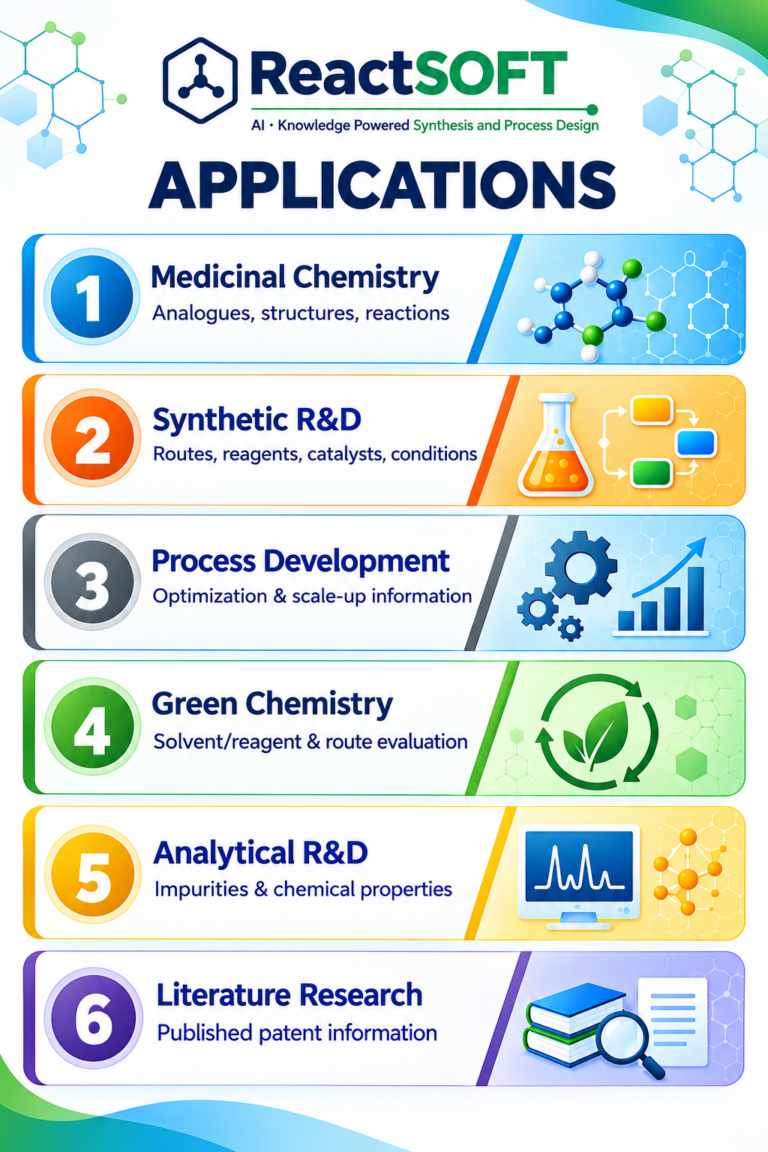
ReactSOFT software will be instrumental to researchers to explore chemical synthetic routes, evaluate and compare reaction conditions, predict potential impurities, understand pKa and ionization behaviour. By reducing reliance on extensive experimental trial-and-error, ReactSOFT, an AI & rule based digital platform will help accelerate chemical R&D, improve process efficiency, and support the development with safer, cost-effective, scalable, and more sustainable synthetic processes.
Major challenges in chemical synthesis:
Multiple synthetic routes
Difficult to identify the most efficient and scalable route of synthesis.
Reaction condition optimization
Extensive experimentation is often required to select the right catalysts, reagents, and solvents while optimizing yield, selectivity, and process robustness.
Impurity formation
Impurity formation increases purification complexity, reduces yield, raises manufacturing costs, and creates additional analytical, quality-control, and regulatory challenges during process development.
Selection of starting-material
Identifying suitable and commercially available starting materials can delay experimental work and increase development costs.
Low reaction yield
Reduces material efficiency, increases raw-material consumption and manufacturing costs, and often requires additional optimization and processing steps.
Lack of green synthesis routes
Conventional synthetic routes may rely on toxic solvents, stoichiometric reagents, and energy-intensive conditions, increasing environmental impact, and safety risks.
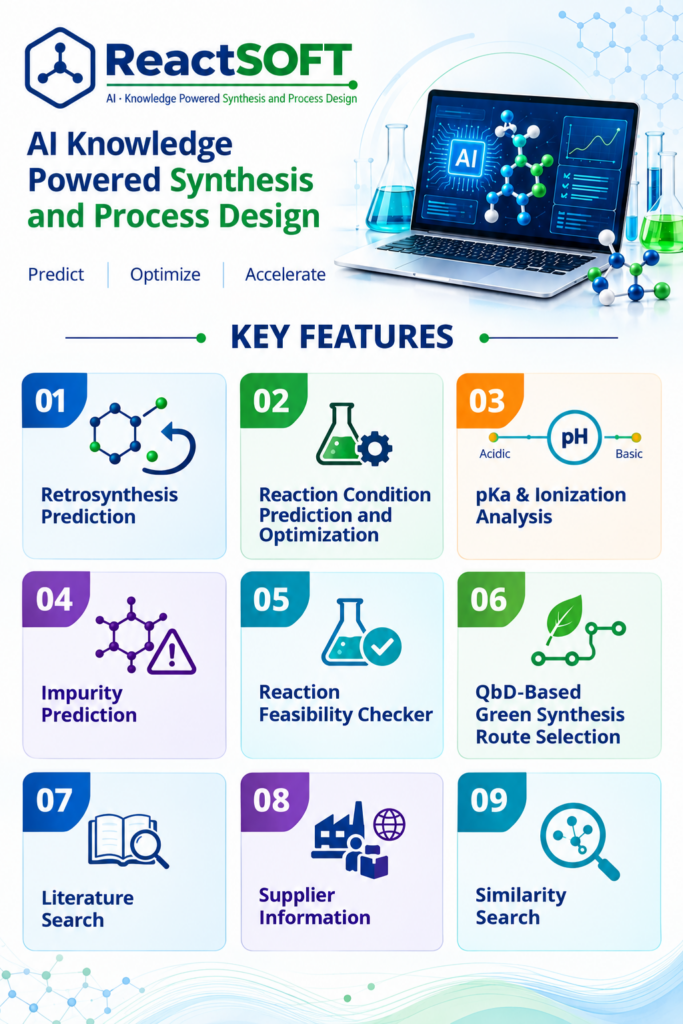
Key features of ReactSOFT:
AI-Assisted Retrosynthesis
Identifies suitable disconnections, starting materials, and synthetic routes.
Reaction Condition Prediction and Optimization
Recommends reagents, catalysts, solvents, molar ratios, and temperatures.
pKa and Ionization Analysis
Evaluates ionization behaviour and reactivity of chemical compounds.
Impurity Prediction
Predicts potential by-products, degradation products, and side products.
Reaction Feasibility Checker
Assesses route feasibility and supports selection of suitable synthetic pathways.
Quality by Design (QbD)-based Green Synthesis
Identifies routes that minimize waste, hazards, energy use, and environmental impact.
Supplier Information
Provides information on commercially available chemicals and their suppliers.
Literature Review
Finds published patent information on compounds and reactions
Similarity Search
Finds similar compounds and reactions for faster research and design
Why ReactSOFT for Smarter Chemical Synthesis?
Predictive Decision Making – Combine chemical knowledge, reaction rules, and predictive models to guide faster and more efficient synthesis decisions.
Reduced Experimental Work – Use AI-driven insights to reduce trial-and-error experimentation and accelerate process development.
Process Efficiency – Support the selection of efficient reaction conditions, solvents, and reagents for process development.
Safety & Risk Assessment – Identify potential reaction and process hazards earlier in synthetic development.